
Key takeaways
- AI-driven BPM replaces headcount-led outsourcing with a hybrid model: AI agents handle intake, extraction, classification and routing, while trained operations staff own exceptions, compliance and judgment calls.
- Back-office functions are where financial services AI is actually running at scale. In the Cambridge Centre for Alternative Finance 2026 Global AI in Financial Services Report, four of the top five AI use cases across financial institutions are back-office functions, with process automation at 79% pilot stage or beyond.
- Insurance workflows with the fastest payback are FNOL and claims intake, submission triage, endorsements, COI requests and renewal prep. In banking, they are reconciliation, document verification, regulatory reporting support, KYC and AML review, and credit processing support.
- The constraint is rarely the model. It is data readiness, workflow design, governance and change management.
- A realistic sequence is one pilot workflow in 8 to 12 weeks, measured against cost per transaction, cycle time, straight-through-processing rate and error rate, then scaled workflow by workflow.
What is AI-driven BPM?
AI-driven BPM (Business Process Management) is an operating model in which AI systems execute the repetitive, rules-based portions of a business process end to end, while humans supervise outputs, resolve exceptions and hold accountability for compliance. It differs from traditional automation because the AI layer handles unstructured inputs such as emails, PDFs, scanned forms and free-text notes, and it differs from traditional BPO because capacity no longer scales with headcount.
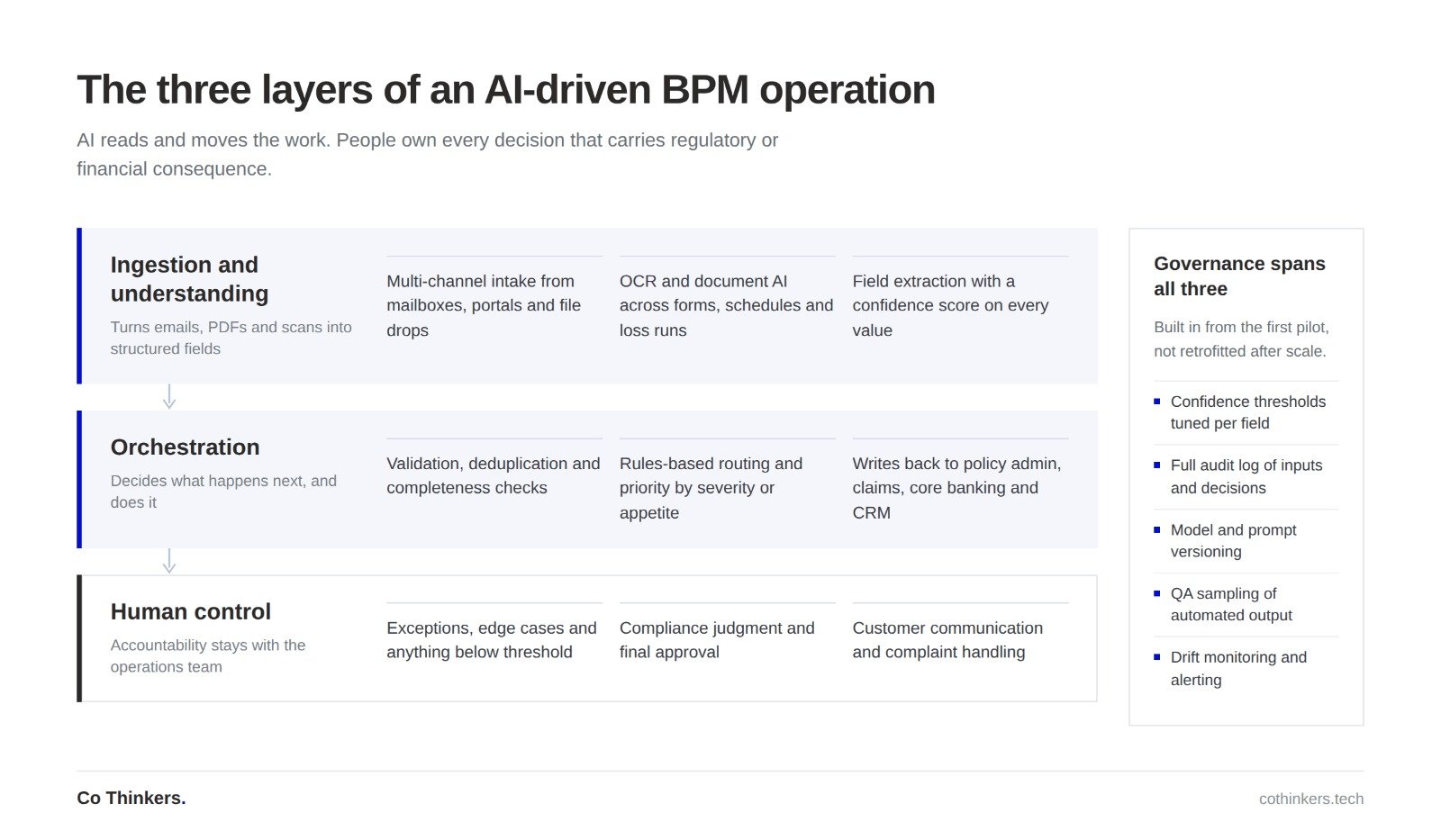
In insurance and banking back offices, that usually means three layers working together:
- An ingestion and understanding layer. OCR, document AI and language models that read submissions, claim notices, endorsement requests, statements and correspondence, and convert them into structured fields.
- An orchestration layer. Business rules, workflow engines and AI agents that validate, deduplicate, route, pre-populate systems of record and trigger next actions.
- A human control layer. Operations staff who review flagged items, handle edge cases, manage customer communication and sign off on anything that carries regulatory or financial risk.
Why insurance and banking back offices are ripe for AI right now
Three conditions have lined up at the same time.
The work is document-heavy and email-driven. Submissions, loss runs, endorsements, certificates, KYC packs, trade confirmations and regulatory returns all arrive as unstructured artefacts. That was exactly the category of work that legacy RPA could not touch, because RPA needs a stable screen and a predictable field, not a forwarded PDF with a handwritten annotation.
The economics are now documented, not theoretical. McKinsey's 2026 insurance analysis reports customer onboarding cost reductions of 20 to 40 percent and measurable improvements in claims processing accuracy for carriers running a domain-based AI strategy. Industry reporting across carriers and BPO providers puts claims handling cost reduction in the 25 to 40 percent range and cycle time reduction between 30 and 70 percent for automated intake and triage workflows.
Most firms are still early, which is the opportunity. The CCAF 2026 report found that only 40% of financial services respondents report increased profitability from AI, and 55% find it difficult to measure the value of AI deployment at all. Grant Thornton's 2026 banking AI survey found that a significant share of banks are not confident they could pass an independent audit of their AI governance and controls. Adoption is broad. Operational maturity is not.
That gap between adoption and maturity is the real market. Most insurers and banks do not need to be convinced that AI works. They need someone to redesign the workflow, wire the governance and prove the numbers on one process before touching the rest.
Traditional outsourcing vs AI-driven BPM: what actually changes
| Dimension | Traditional BPO | AI-driven BPM (hybrid model) |
|---|---|---|
| Capacity model | Scales with headcount | Scales with compute and workflow design |
| Handling of volume spikes | Hire, train, ramp over weeks | Absorbed within the same team |
| Unit economics | Cost per FTE per month | Cost per transaction, falling over time |
| Document handling | Manual keying and review | AI extraction with confidence scoring |
| Human role | Process execution | Exception handling, QA, judgment, relationships |
| Error profile | Fatigue and volume-driven errors | Model errors caught by confidence thresholds and QA sampling |
| Speed of change | Retrain the team, rewrite the SOP | Update prompts, rules and thresholds |
| Auditability | Sampling and supervisor sign-off | Logged decisions, versioned models, full traceability |
The economic shift is the part that matters to a CFO. In a headcount-led model, doubling volume roughly doubles cost. In an AI-led model, doubling volume increases compute cost and a small amount of review capacity, which is why cost per policy, per claim or per transaction keeps falling as volume grows.
The mistake is treating this as a replacement decision. The highest performing operations are not "AI instead of BPO". They are AI executing the first pass, with an experienced operations team owning everything the AI is not qualified to decide.
High-value AI use cases in insurance BPM
1. Submission intake and triage
Before: Submissions arrive in shared mailboxes. Staff open each email, identify the broker and insured, check for duplicates, extract ACORD data, and route to the right underwriting queue. Turnaround is measured in hours, duplicates slip through, and appetite mismatches consume underwriter time.
After: AI classifies the email, extracts named insured, effective dates, limits and exposures from attached ACORD forms and schedules, checks against existing submissions to catch duplicates, applies appetite rules, and routes to the correct queue with a completeness score. Staff review only low-confidence and out-of-appetite items.
What to measure: submissions triaged per hour, duplicate detection rate, time from receipt to underwriter queue, quote turnaround.
2. Claims intake and FNOL
Before: First Notice of Loss arrives by email, portal, phone notes and PDF. Adjusters re-key details, chase missing information, and set up the claim manually.
After: AI captures loss details from any channel, validates the policy in force at the date of loss, flags missing mandatory fields before the file moves forward, drafts the initial claim record, and routes based on severity and complexity. Fraud models surface anomalies at intake instead of three weeks later.
What to measure: time to claim setup, percentage of claims with complete first-pass data, leakage, straight-through-processing rate on low-complexity claims.
3. Policy administration and endorsements
Before: Endorsement requests arrive as free-text emails. Staff interpret intent, validate completeness, then key changes into the policy admin system.
After: AI reads the request, classifies the endorsement type, checks for required supporting information, pre-populates the change in the policy admin system, and queues it for human confirmation before it is committed.
What to measure: endorsements processed per FTE per day, rework rate, error rate post-issuance.
4. Certificate of Insurance (COI) requests
Before: High-volume, low-value, deadline-driven, and a constant source of service complaints.
After: AI parses the request, retrieves the named insured and policy details, checks contractual requirements against coverage, and prepares a draft certificate for human review and issuance.
What to measure: COI turnaround time, percentage issued same day, service escalations.
5. Renewal prep and remarketing
Before: Analysts manually pull expiring policy terms, loss runs and exposure changes into a spreadsheet before the account manager can act.
After: AI summarises the expiring policy, extracts and normalises loss runs across carriers, highlights exposure changes, and produces a structured renewal pack that the team reviews and prices.
What to measure: renewals prepped per analyst, retention rate, percentage of renewals worked more than 60 days out.
High-value AI use cases in banking BPM
1. Reconciliation and exception management
AI matches transactions across systems, explains breaks in plain language, proposes a resolution, and escalates only genuine exceptions. Operations teams shift from finding breaks to approving resolutions.
2. Document verification, KYC and periodic review
AI extracts and validates identity and entity documents, cross-checks registries and internal records, flags inconsistencies, and assembles the review pack. Analysts adjudicate rather than assemble.
3. AML alert triage and narrative drafting
AI clusters related alerts, gathers supporting transaction context, drafts the investigation narrative, and ranks alerts by risk. Investigators keep full decision authority, which is non-negotiable, and get back the hours previously spent on evidence gathering.
4. Credit processing support
AI reads financial statements, bank statements and supporting documents, populates the spreading template, computes covenants and ratios, and drafts the credit summary for the analyst to challenge and finalise.
5. Regulatory reporting and controls evidence
AI validates data against reporting rules, reconciles across submissions, and drafts supporting documentation such as model risk write-ups and internal audit narratives, with every source traceable.
The pattern is identical across both industries: AI assembles, humans decide.
Designing the hybrid AI + human operating model
This is the section most AI projects skip, and it is the reason most of them stall after the pilot.
Draw the line between AI work and human work explicitly
| AI should own | Humans must own |
|---|---|
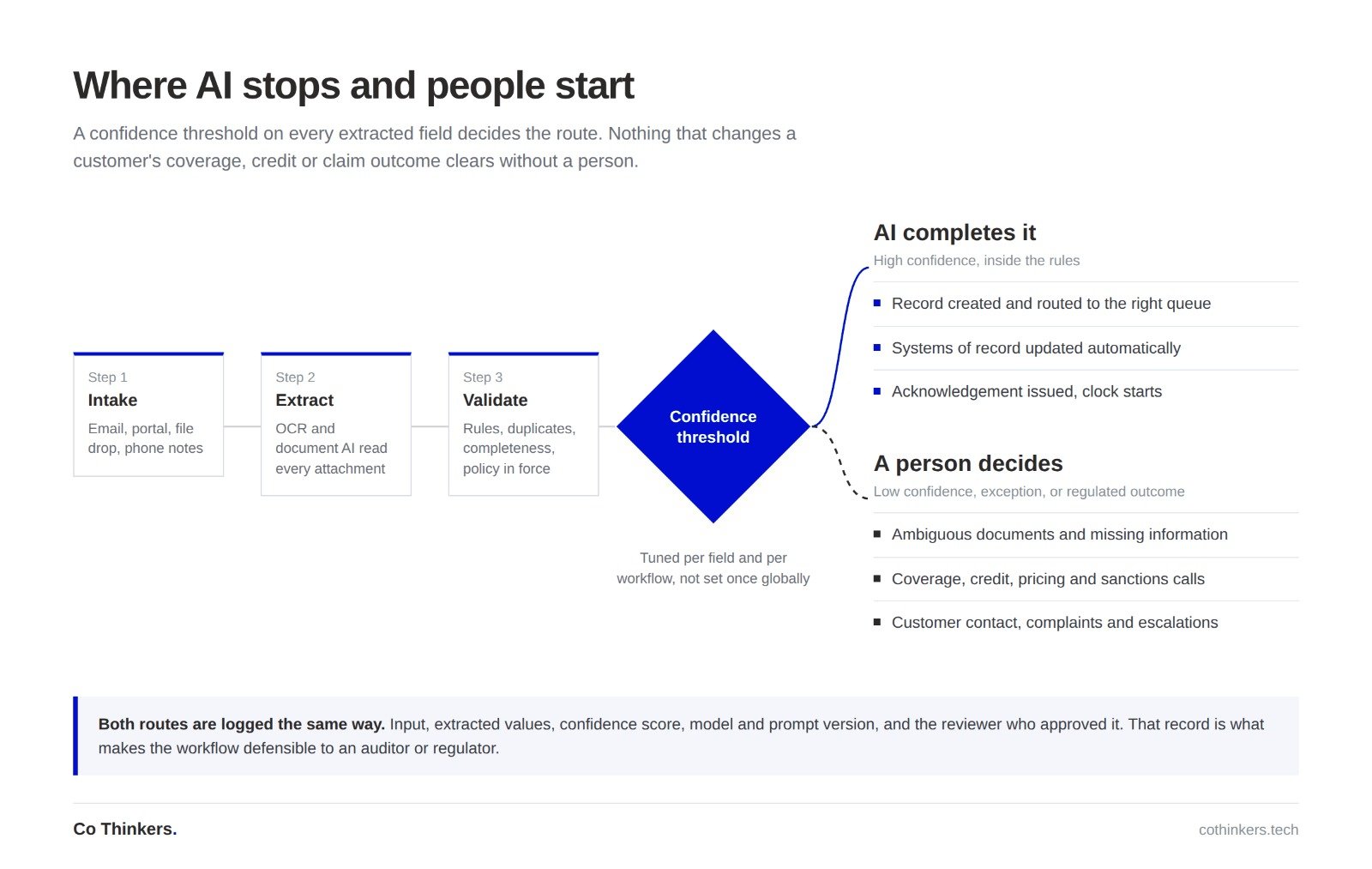
| Reading, extracting and structuring documents | Any decision that changes a customer's coverage, credit or claim outcome |
| Classification, deduplication and routing | Exceptions, ambiguity, and anything below the confidence threshold |
| Validation against rules and checklists | Regulatory judgment and defensible rationale |
| Drafting summaries, narratives and correspondence | Final review, approval and customer communication |
| Flagging anomalies and missing information | Relationship management and complaint handling |
Build the control plane before you scale
A production AI-driven BPM programme needs, at minimum:
- Confidence thresholds that decide automatically what routes to human review, tuned per field and per workflow rather than globally.
- Full audit logging. Every extraction, decision, model version and prompt version recorded against the transaction, so a regulator or auditor can reconstruct why an outcome occurred.
- Ongoing QA sampling of automated outputs, not just of human work, with drift monitoring so degradation is caught before customers feel it.
- Human-in-the-loop by design on anything touching pricing, coverage, credit decisions, sanctions or customer money.
- Data governance covering where documents are processed, what is retained, and how personal data is handled under the applicable regime, which for Indian institutions increasingly means aligning with the DPDP framework and sectoral regulator expectations, and for EU exposure means understanding where a use case sits under the EU AI Act risk tiers.
Plan the change management, not just the build
McKinsey's guidance on insurance AI adoption is blunt on this point: match the development spend with equivalent investment in change management. Operations teams that were measured on throughput now need to be measured on exception quality. Supervisors need new dashboards. QA needs a new sampling methodology. If none of that changes, the AI gets ignored and the team quietly keeps doing the work manually.
A six-step roadmap for insurers and banks
- Map the operation and find the volume. Inventory back-office workflows by volume, cost per transaction, cycle time and error rate. The candidates that matter are high-volume, rules-heavy and document-driven.
- Set the numbers you will be judged on. Baseline cost per transaction, cycle time, straight-through-processing rate, error and rework rate, and SLA adherence before anything is built. Without a baseline there is no ROI story, and this is precisely why more than half of financial institutions say they cannot measure AI value.
- Pick one pilot workflow. Choose one with clean data availability, a contained blast radius and a measurable outcome. Submission triage, FNOL intake and reconciliation are the usual first choices. Eight to twelve weeks is a realistic pilot window.
- Design the hybrid model before building. Define AI scope, human roles, confidence thresholds, escalation paths, audit requirements and integration points into the policy admin, claims, core banking or CRM system.
- Run, measure, tune. Track the KPIs weekly. Tune thresholds and extraction logic against real exceptions. Expect the first four weeks to be about accuracy and the next four to be about throughput.
- Scale workflow by workflow. Reuse the ingestion, orchestration and governance layer across the next process instead of rebuilding. This is where the compounding return sits, because process two and three cost a fraction of process one.
KPIs worth tracking from day one
| KPI | Why it matters |
|---|---|
| Cost per transaction | The headline ROI metric, and the one a CFO will ask for first |
| Cycle time | Directly tied to customer experience and retention |
| Straight-through-processing rate | Measures how much work genuinely left the queue |
| Exception rate and exception quality | Shows whether AI is offloading work or just relocating it |
| Error and rework rate | Guards against speed gains bought with accuracy losses |
| SLA adherence | The number your clients and regulators actually see |
Four failure modes to avoid
- Automating a broken process. If the workflow is badly designed, AI produces bad outcomes faster. Redesign first, then automate.
- Piloting without a baseline. Without before-numbers, a successful pilot is indistinguishable from an expensive one.
- Treating governance as a later phase. Retrofitting audit trails and controls onto a live AI workflow in a regulated environment costs more than building them in.
- Buying a tool instead of designing an operating model. The technology is the smallest part of the problem. The operating model, the human roles and the controls are the work.
What to look for in an AI-driven BPM partner
Most vendors in this market sit on one side of a gap. BPO providers understand the process but not the AI architecture. AI vendors understand the models but have never run a claims queue or an AML desk. The partner worth hiring can do four things together:
- Workflow discovery grounded in how insurance and banking operations actually run, including the exceptions.
- AI solution design covering document AI, language models, orchestration and agent design, with confidence thresholds and human checkpoints built in.
- Systems integration into policy administration, claims, core banking, CRM and reporting platforms, without a core replacement programme.
- Operating model and change management so the hybrid model survives contact with the team that has to run it.
Frequently asked questions
What is AI-driven BPM in insurance and banking?
AI-driven BPM is a business process management model where AI systems execute document-heavy, rules-based back-office work such as intake, extraction, classification and routing, while trained operations staff handle exceptions, compliance and final decisions. It differs from RPA because it handles unstructured inputs, and from traditional BPO because capacity no longer scales with headcount.
Will AI replace insurance BPO?
No. The dominant model is hybrid. AI executes the first pass on repetitive work, and experienced operations teams handle exceptions, regulatory judgment, complex decisions and customer communication. What changes is the cost curve, because volume growth no longer requires proportional headcount growth.
Which back-office processes should be automated first?
Start with high-volume, rules-based, document-driven workflows where data is available and the outcome is measurable. In insurance, that is typically submission triage, FNOL and claims intake, endorsements and COI requests. In banking, it is reconciliation, document verification, KYC review and regulatory reporting support.
How much can AI reduce back-office costs in insurance and banking?
Reported outcomes vary by workflow and starting maturity. Industry reporting places claims handling cost reduction in the 25 to 40 percent range, McKinsey reports 20 to 40 percent reductions in customer onboarding costs for insurers with a domain-based AI strategy, and cycle time reductions of 30 to 70 percent are commonly reported on automated intake and triage workflows. Treat these as benchmarks to validate against your own baseline, not as guarantees.
How long does an AI BPM pilot take?
A focused pilot on a single workflow typically runs eight to twelve weeks from discovery to measured results, assuming reasonable data access. Scaling across additional workflows is faster because the ingestion, orchestration and governance layers are reused.
What about compliance and auditability?
Every automated decision should be logged with its inputs, confidence score, model version and the human who reviewed it. Anything affecting coverage, credit, pricing, sanctions or customer money should stay under human approval. Governance is designed in from the start, because retrofitting it in a regulated environment is significantly more expensive.
What is agentic AI in banking back-office operations?
Agentic AI refers to systems that execute multi-step workflows autonomously rather than performing a single task, for example gathering documents, validating data across systems, drafting a summary and updating a record in sequence. In banking back offices it is being applied to reconciliation, regulatory data validation, fraud risk identification and documentation drafting, with humans managing exceptions and oversight.
Do we need to replace our core systems first?
Usually not. Most AI-driven BPM work sits around the core, integrating through APIs, file exchanges and workflow tools. Core modernisation may still be warranted for other reasons, but it is not a prerequisite for automating intake, triage and document processing.