Key takeaways
- Workflow automation is splitting into two tiers. Simple trigger-action tools still handle linear, deterministic tasks well, but a second tier — AI agent orchestration — is where the real productivity gains now sit, and n8n has become the leading open-source platform for building it.
- n8n has grown rapidly on the back of this shift, reportedly raising $180 million at a $2.5 billion valuation as it repositions from "Zapier alternative" to "AI agent orchestration layer," with native AI agent nodes, LangChain integration and self-hosting as core differentiators.
- The AI agent automation market itself is projected to grow from roughly $5 billion in 2024 to over $47 billion by 2030 — a compound annual growth rate above 45% — as businesses move from single trigger-action automations to agents that plan, decide and act across multiple steps.
- 82% of large enterprises in a recent survey said they plan to integrate AI agents within one to three years, and 90% of companies already using AI agents report smoother workflows, with employees seeing an average efficiency gain above 60%.
- The right automation tool depends on the shape of the problem, not brand loyalty: linear, deterministic tasks still fit simple tools like Zapier or Make; conditional, multi-step, judgment-involving workflows are where n8n's AI agent nodes and self-hosted flexibility earn their cost.
Why "automation" means something different now
For most of the last decade, workflow automation meant one thing: if this happens, then do that. A form submission triggers a Slack message. A new CRM entry creates a calendar event. That model is not going away — it still covers a large share of what small businesses need — but it is no longer the whole story.
The newer layer is orchestration: AI agents making decisions, routing tasks conditionally, querying knowledge bases, calling multiple models, and executing multi-step processes that adapt based on what they find along the way. That is qualitatively different work, and it needs a different kind of tool underneath it.
Why n8n specifically has become the default for this shift
n8n started in 2019 as a self-hosted, open-source alternative to Zapier. What changed its trajectory was the addition of first-class AI agent nodes — building blocks that let a workflow include an agent calling multiple tools, reasoning about the result, and deciding what to do next, all inside the same visual canvas used for simpler automations.
Three things distinguish it from the assistant-style automation tools most businesses already know: it is open source and self-hostable, which matters at volume because the cost model shifts from per-task pricing to near-flat infrastructure cost; it has native LangChain-style AI agent support built in rather than bolted on; and it gives technical teams the option to drop into custom JavaScript or Python code inside a workflow when a visual node isn't enough.
Simple automation vs AI agent orchestration
| Dimension | Simple trigger-action automation | AI agent orchestration |
|---|---|---|
| Logic | If this happens, then do that — deterministic | Agent plans, calls tools, evaluates results, adapts |
| Best fit | Linear, predictable, high-volume tasks | Conditional, judgment-involving, multi-step processes |
| Typical tools | Zapier, Make, IFTTT | n8n with AI agent nodes, custom agent frameworks |
| Pricing model | Per-task or per-zap, scales with volume | Often self-hosted — near-flat infrastructure cost at scale |
| Setup complexity | Low — built for non-technical users | Higher — most value unlocked by a technical team |
| Failure mode if misapplied | Breaks silently on any exception it wasn't built for | Overkill and unnecessary complexity for a truly linear task |
High-value automation use cases businesses are actually running
1. Sales outreach and lead qualification
Before: A rep manually researches each inbound lead, drafts a personalized outreach message, and logs the activity in the CRM — ten to fifteen minutes per lead, every time.
After: An agent-driven workflow enriches the lead, drafts a personalized message, scores it against your ideal customer profile, and routes qualified leads to a rep with the research already attached.
What to measure: time to first outreach, lead qualification accuracy, rep hours saved per week.
2. Customer support triage and first response
Before: Every inbound support request sits in a shared queue until a human has time to read, categorize and route it.
After: An agent reads the request, checks account and order history via connected tools, drafts or sends a resolution for simple cases within policy, and routes complex cases to a human with full context attached.
What to measure: first-response time, percentage resolved without human involvement, escalation accuracy.
3. Content and reporting workflows
Before: Weekly and monthly reports are assembled manually by pulling data from three or four different tools into a spreadsheet.
After: A scheduled workflow pulls data from every connected system, an agent drafts the narrative summary, and the finished report lands in Slack or email before anyone has to ask for it.
What to measure: hours saved per reporting cycle, time from period close to report delivery.
4. Internal operations and approvals
Before: Purchase requests, time-off approvals and vendor onboarding all move through email threads and manual follow-ups.
After: A workflow routes the request automatically, an agent checks it against policy, approves straightforward cases or flags exceptions for a human, with full audit logging of every decision.
What to measure: approval cycle time, percentage requiring manual escalation.
Request a workflow automation audit
A short audit of one workflow to show where simple automation is enough and where AI agent orchestration earns its cost.
Schedule a strategy session Talk to our teamGetting AI agent automation right: what has to be in place first
- Human-in-the-loop on anything consequential. n8n's own 2026 roadmap has prioritized human review checkpoints between agents and tools, reflecting the same governance principle that applies to any agentic deployment — approve the boundary, not every action.
- Clean, connected data. An orchestration layer is only as good as the systems it can actually query — if your CRM, helpdesk and billing tool don't talk to each other, the agent inherits that fragmentation.
- A realistic starting workflow. Pick one process with clear rules and a measurable outcome — lead routing or support triage are common first choices — rather than trying to automate an entire department at once.
- Monitoring and rollback. Every automated workflow needs a way to catch a bad run before it compounds, and a clear path to pause or revert it.
Frequently asked questions
What is the difference between n8n and Zapier?
Zapier and similar tools are built for simple, linear trigger-action automations aimed at non-technical users. n8n is open source, self-hostable, and includes native AI agent nodes that let a workflow reason, call multiple tools and adapt — better suited to technical teams building more complex, judgment-involving automations.
Is AI agent automation only for large enterprises?
No. Self-hosted tools like n8n specifically lower the cost barrier for smaller businesses, since pricing shifts from per-task fees to near-flat infrastructure cost — making high-volume automation economically viable well below enterprise scale.
How big is the AI agent automation market becoming?
Analysts project the market growing from roughly $5 billion in 2024 to more than $47 billion by 2030, an annual growth rate above 45%, as businesses shift from simple trigger-action tools toward agent-driven orchestration.
Do AI agents in automation workflows replace employees?
In most deployments, no — they absorb the repetitive, high-volume portion of a workflow while employees handle exceptions, judgment calls and relationship-dependent work. 90% of companies using AI agents report smoother workflows and meaningful efficiency gains, not headcount elimination.
What should my business automate first?
Start with one workflow that has clear rules and a measurable outcome — lead routing, support triage, or a recurring reporting process are the most common and reliable first choices for most growing businesses.
Is self-hosted automation harder to maintain than a SaaS tool?
It requires more technical setup upfront, but for high-volume workflows it typically costs meaningfully less to run over time, and gives a business full control over where its data is processed and stored.
Sources
- n8n 2026 roadmap and company statements
- Industry reporting on n8n funding, valuation and market positioning, 2026
- Unite.AI, AI agents for business automation market analysis, 2026
This is general information on automation and AI agent trends, not a guarantee of outcomes for any specific business — validate figures against your own workflow before using them in a customer-facing claim.
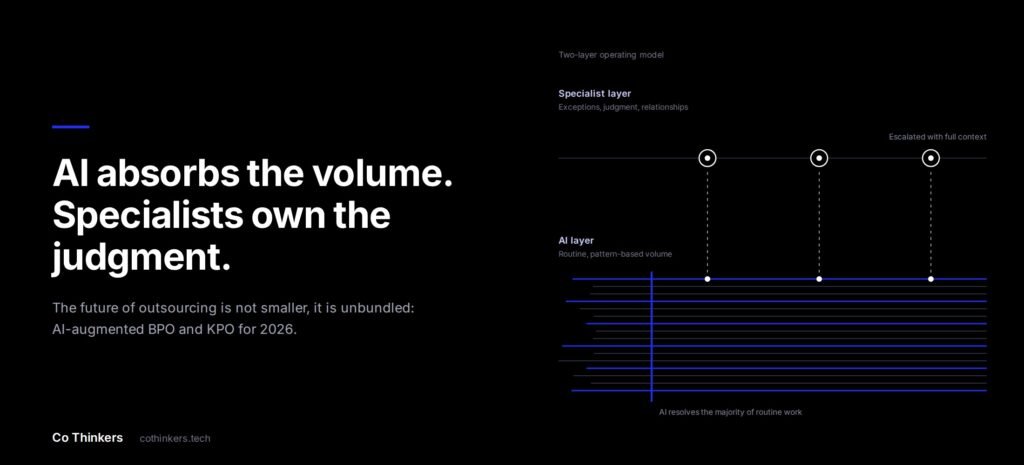
Co Thinkers designs and builds n8n and AI agent automation for sales, support, finance and internal operations workflows.
Shakti Chaturvedi
Founder, Co Thinkers. Co Thinkers is a technology and business operations partner working with banks, insurers and high-growth companies across product engineering, AI systems and process transformation.